3 & 4 Roller Mills with Rotor Classifier
- Home
- /
- 3 & 4 Roller Mills with Rotor Classifier

Principle
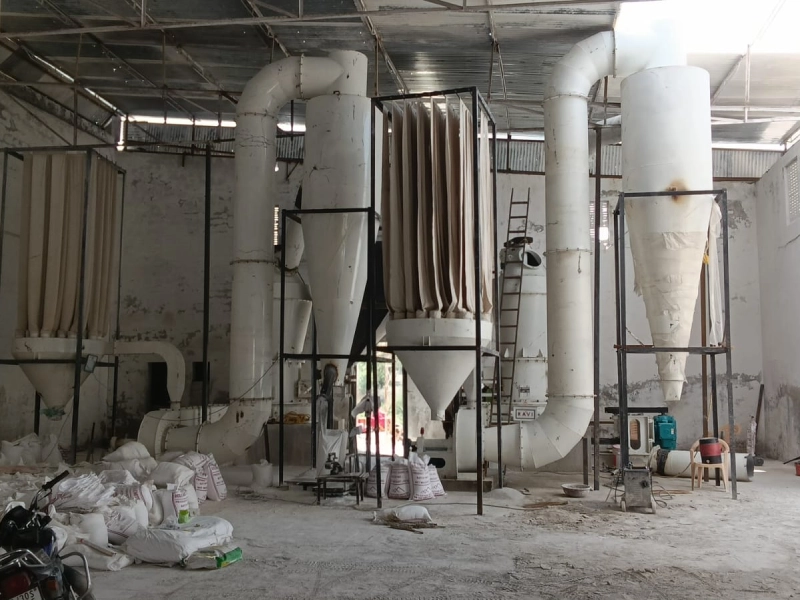
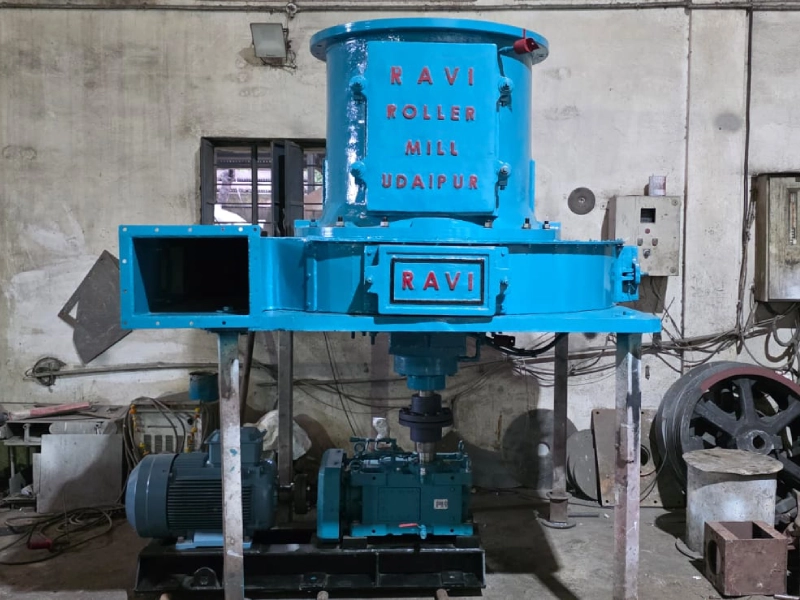
3/4 roller mill works on the pressure & friction grinding system. The grinding is done between the stationary bull ring and the rotating rollers, which swing outward due to the centrifugal force.
Control and Operation
The mill base is made from cast iron. The air chamber, blower, dust collector, and duct lines is made from the mild steel. The gear box of cast iron and have one set of hardened bevel gear. The vertical shaft has plough support, Plough – made of Manganese Iron and spider with the rollers which is hinged on spider. The thrust bearing is provided in the bottom of vertical shaft to hold the load of shaft assembly. The feeder is provided to feed the material in grinding chamber as and when required. The grounded material is swept by air and carried to the classifier. The Rotor Classifier passes the material of required mesh and oversized particles are returned to the grinding chamber. Finally material is collected by cyclone.
Engineered Performance Overview
These 3 and 4-roller mills are ideal for processing a wide range of minerals, specifically Barites, Bentonite, Dolomite, Calcite, Limestone, Coke, Red Oxide, Manganese Oxide, and Marble.
| 3 & 4 ROLLER MILL WITH ROTOR CLASSIFIER | ||||||
|---|---|---|---|---|---|---|
| MACHINE SIZE |
DIMENSIONS IN MTR. |
FEED SIZE | OUTPUT MESH |
PRODUCTION- KG/HR. |
POWER(HP) | KWH UNIT |
| 3 Roller Mill | 6.50 x 6.60 x 6.00 | < 20 mm | 200-500 | 1500-500 | 30+25+7.5 | 38 |
| 4 Roller Mill | 6.00 x 6.00 x 7.00 | < 20 mm | 200-500 | 2500-800 | 40+30+12.5 | 48-50 |
* Power Consumption and Production output may vary by ±10%, depending on the hardness, grindability, and behaviour of the mineral.